

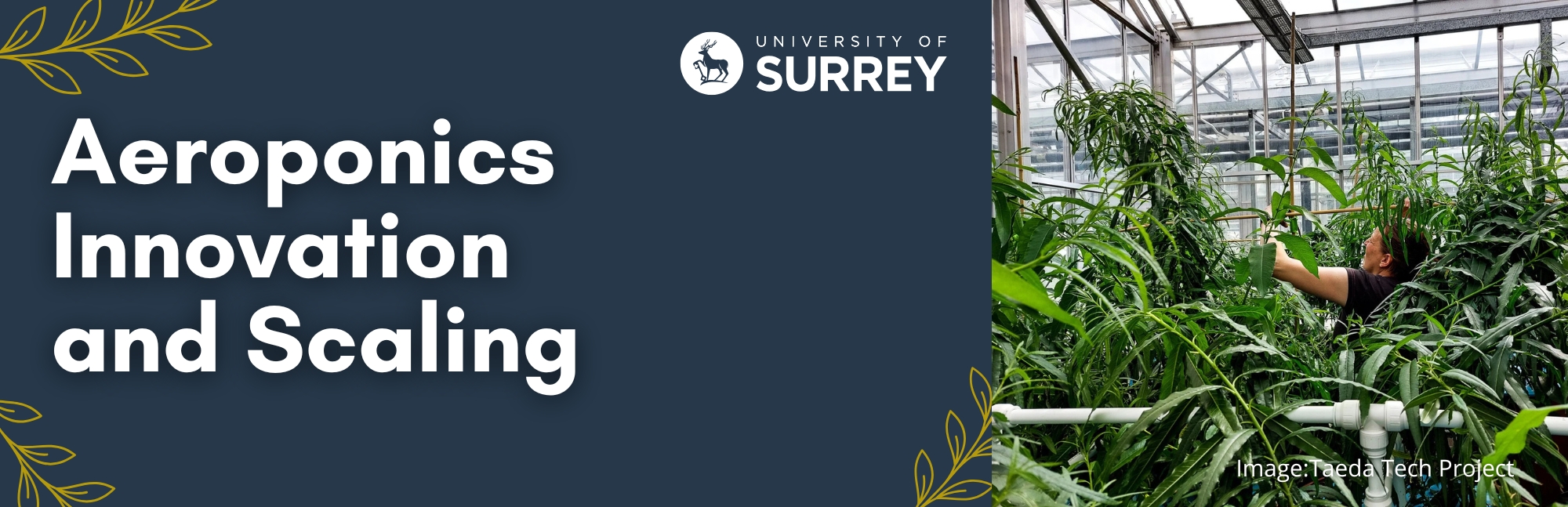
Aeroponics Innovation and Scaling

Modern agriculture stands at a critical crossroads. Escalating global food demand, climate instability, water scarcity, and the urgent transition toward low-carbon production systems are accelerating the need for smarter, more resilient cultivation technologies.
Aeroponics offers a powerful and forward-thinking approach which can complement traditional agricultural cultivation. By delivering nutrients directly to suspended plant roots within a precisely controlled mist environment, this advanced system achieves exceptional productivity while dramatically reducing water consumption, disease pressure, and resource inputs compared to traditional soil-based methods.
This comprehensive two-day CPD programme is designed to move participants beyond foundational knowledge toward applied technical competence, sustainability evaluation, and commercial awareness.
Drawing on the research expertise and applied innovation of the researchers at the University of Surrey, the programme bridges cutting-edge Controlled Environment Agriculture (CEA) research with practical implementation and enterprise potential.
This programme is well-suited to:
- Organisations considering investment in modern cultivation systems.
- Students and early-career professionals
- Horticultural technicians and educators
- Industry professionals exploring CEA integration
Learning outcomes
By the end of this two-day CPD course, participants will be able to:
- Demonstrate understanding of the scientific and engineering foundations of aeroponic systems
- Apply knowledge of system setup, operation, optimisation, and troubleshooting
- Critically evaluate sustainability benefits, including water efficiency and carbon reduction
- Analyse the role of precision environmental control in crop quality and productivity
- Identify realistic pathways for educational integration or commercial implementation.
Course content
Day 1: Applied aeroponics and system operation
Day 1 delivers a robust blend of theory and guided practical demonstration, ensuring participants gain both conceptual understanding and operational clarity.
Participants will explore:
- The scientific and engineering principles underpinning aeroponic cultivation
- Root-zone misting dynamics, oxygenation, and nutrient absorption
- Identification and operation of core system components
- High- and low-pressure misting systems and their comparative applications
- Nutrient solution management, including EC and pH monitoring
- Environmental control variables: temperature, humidity, light intensity, and airflow
- System optimisation, diagnostics, and troubleshooting.
Learning is reinforced through structured, hands-on exploration and live system demonstration at our state-of-the-art growing facilities. This applied approach ensures that theoretical concepts are directly connected to real-world operation.
By the end of Day 1, participants will possess the technical confidence to understand, assess, and support aeroponic systems within educational, research, or commercial contexts.
Day 2: Sustainability, precision control and commercial innovation
Day 2 expands the focus from system operation to strategic application – examining why aeroponics is emerging as a critical technology for future-proof agriculture.
Participants will investigate how controlled environment technologies enable growers to monitor and fine-tune key production variables – from nutrient concentration and oxygen delivery to humidity regulation and energy efficiency – supporting consistent production of vigorous, high-quality crops.
Participants will explore:
- Precision nutrient control and data-driven decision making
- Environmental monitoring systems and sensor integration
- Water efficiency and advanced resource optimisation
- Carbon footprint reduction in modern cultivation systems
- Comparative sustainability analysis with traditional agriculture
- Risk management and biosecurity in controlled environments
- Pathways for commercialisation, enterprise development, and innovation.
The programme also explores the commercial landscape of aeroponics, considering how technological advances can be translated into viable products, services, educational provision, or agritech ventures. Structured discussions examine scalability, investment considerations, operational costs, market positioning, and future trends in CEA.